Stories
- Industry
- AI • SaaS • Product Management
- Product
- AI Product Agent
- My Role
- Founding Product Designer
- Team
- Timo Luick (Founding CTO)
Nadja Kohlberger (Founding Product Designer) - Skills
- Product Strategy, Product Discovery, AI Product Design
- Tools
- Codex
- Claude Design
- Lovable
- Figma
- FigJam
- FigR
- ChatGPT
- Notion
- GitHub
- Slack
- Platform
- Desktop Application (for the MVP)
- Status
- MVP in Development
AI Product Agent for Startup Teams
How years of working with founders, CTOs and product teams led to designing an AI Product Agent that helps teams create clarity before development begins.

Opportunity
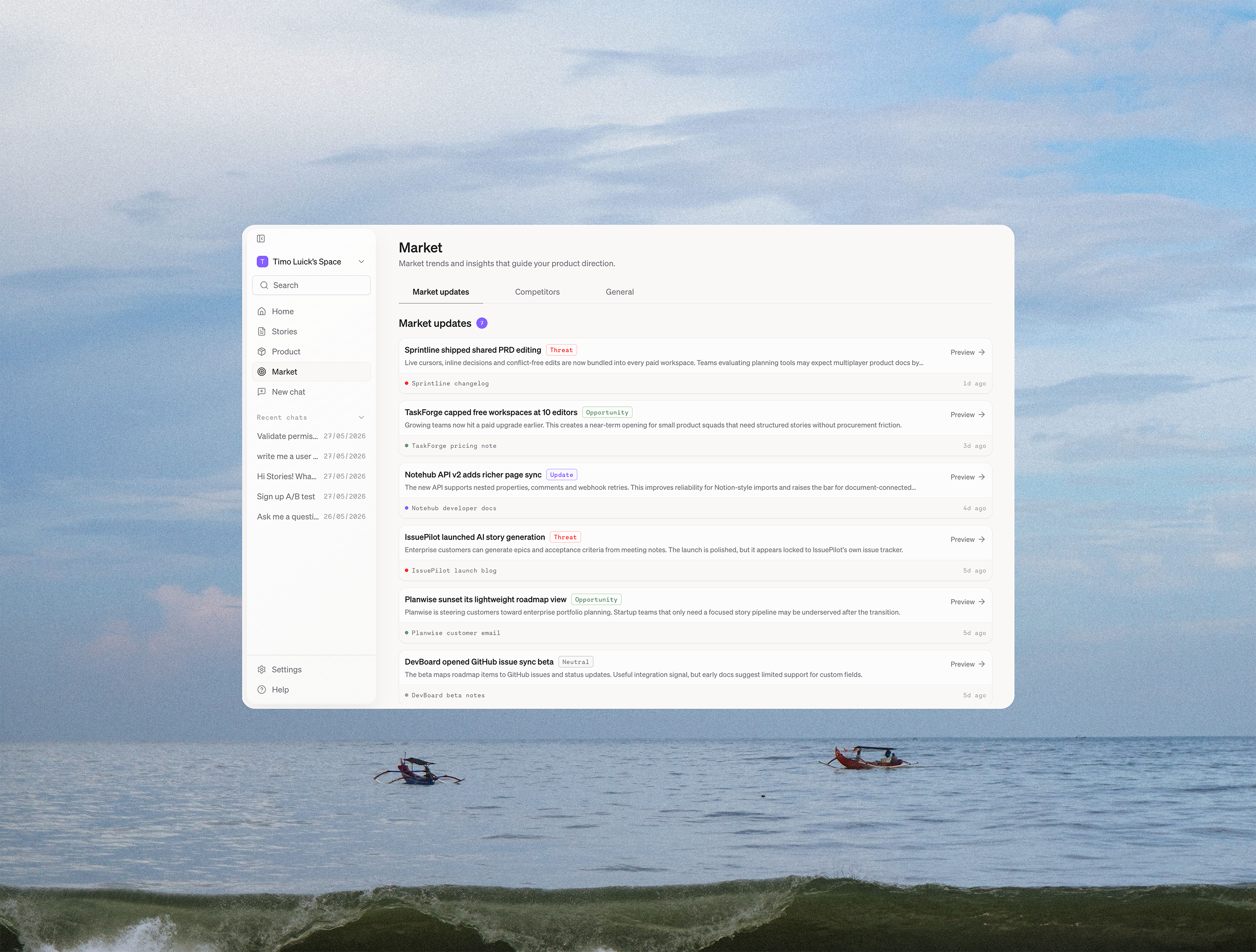
Stories started with a pattern I kept seeing across startup teams. I’ve worked with startups of different sizes, collaborating closely with founders, CTOs, PMs and engineering teams to turn ideas into digital products. Although every company had different challenges, the same issues kept appearing. Maintaining product clarity became increasingly difficult as products evolved. Healthy backlogs were time-consuming to maintain, product decisions were often based on assumptions rather than evidence and valuable context became fragmented across Slack conversations, customer interviews, documentation, analytics platforms and source code.
In many early-stage startups, CTOs balanced engineering with product management, translating business ideas into technical requirements while leading development. Existing project management tools weren’t the issue. The real challenge was that product thinking remained largely manual.
After analysing existing tools and the rapid evolution of AI, I recognised an opportunity to rethink how product teams work. Instead of building another backlog tool, I envisioned an AI Product Agent that understands a product, connects fragmented information across existing tools and helps founders, product teams and developers make better decisions throughout the product lifecycle. To bring that vision to life, I partnered with my former CTO, Timo Luick, with whom I’d collaborated on several startup products over the years. Together we began designing Stories.
Challenge
Designing an AI Product Agent is fundamentally different from designing traditional software. Generating user stories was only a small part of the challenge. The harder problem was designing an AI system that understands technical and business context, reasons across multiple information sources and collaborates with people without taking decision-making away from them.
As the product evolved, we kept coming back to questions like:
- What knowledge should the agent remember?
- How should it connect documentation, customer feedback, analytics and technical context?
- When should it ask questions instead of making assumptions?
- When should humans remain in control?
- How can AI recommendations build trust?
Vision
Stories was built as an intelligent teammate for product teams, not as a replacement for them. Our goal was to create an AI Product Agent that builds an evolving understanding of the product, connects fragmented knowledge and helps teams move from scattered ideas to confident decisions.
We deliberately avoided full automation. Instead, Stories gathers context, drafts recommendations and highlights potential issues while every suggestion remains transparent, reviewable and editable. Over time, this balance between automation and human oversight became one of the principles we kept coming back to whenever we designed a new capability.
Key Decisions
Several decisions shaped the direction of Stories.
Context before generation
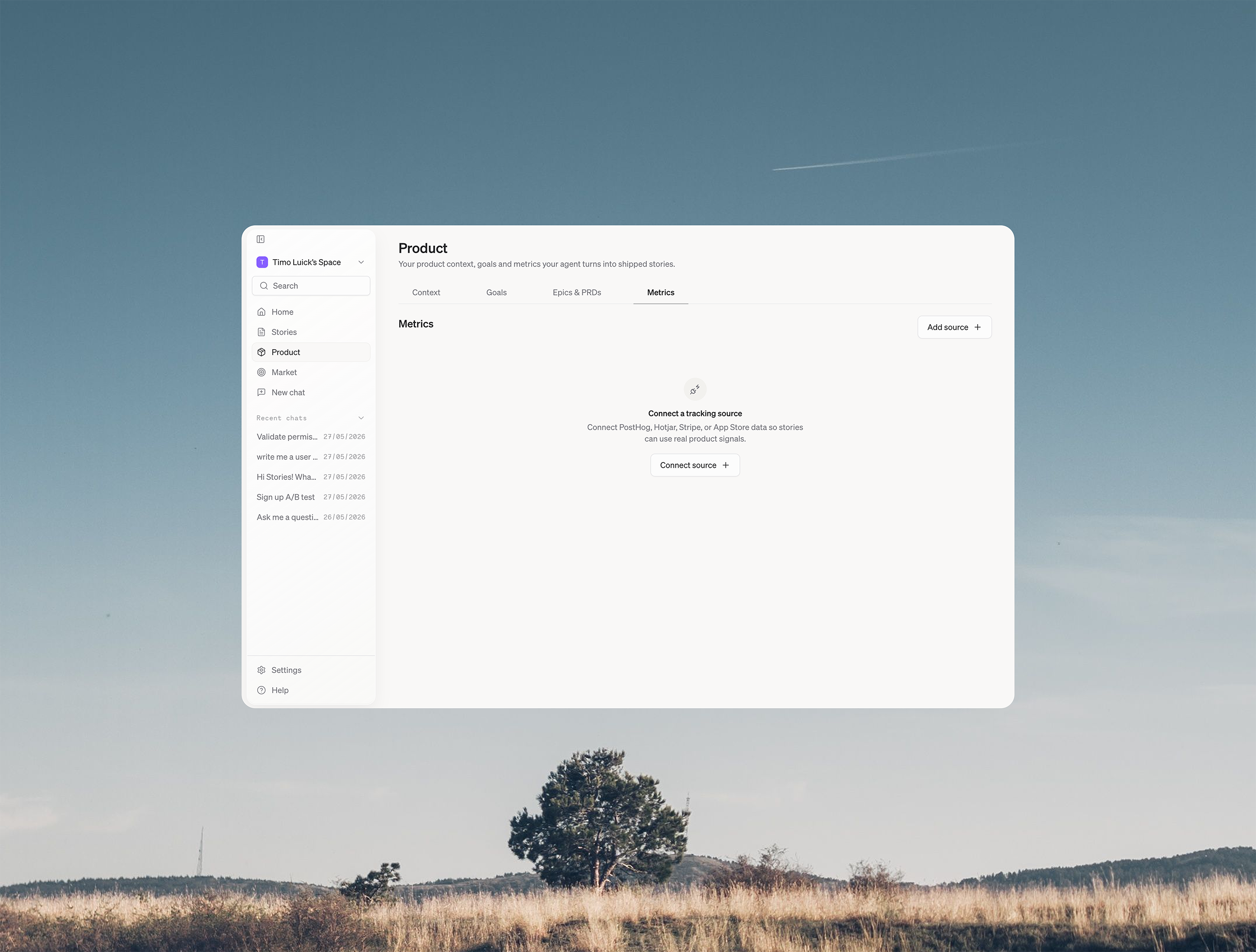
Before generating requirements, the agent first builds an understanding of the product by connecting documentation, repositories, analytics and existing product knowledge. Better context leads to better decisions.
Transparent AI
Recommendations shouldn’t feel like black boxes. Whenever possible, the agent explains its reasoning so teams understand why something is being suggested.
Humans stay in control
Stories reduces repetitive product work while leaving strategic decisions to people.
Build around existing workflows
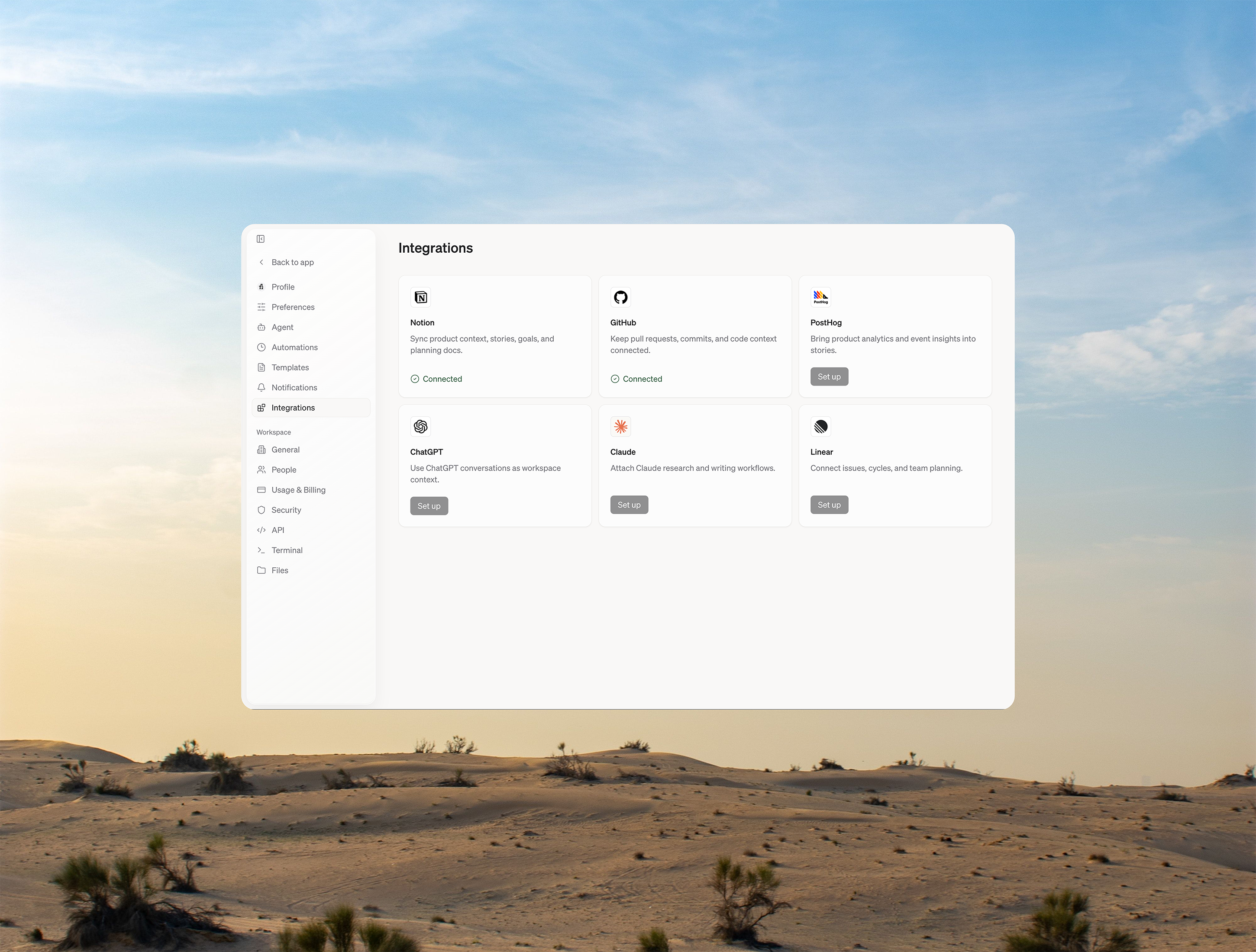
Stories fits naturally into the tools startups already use, allowing teams to adopt it gradually instead of changing the way they work overnight.
Experience
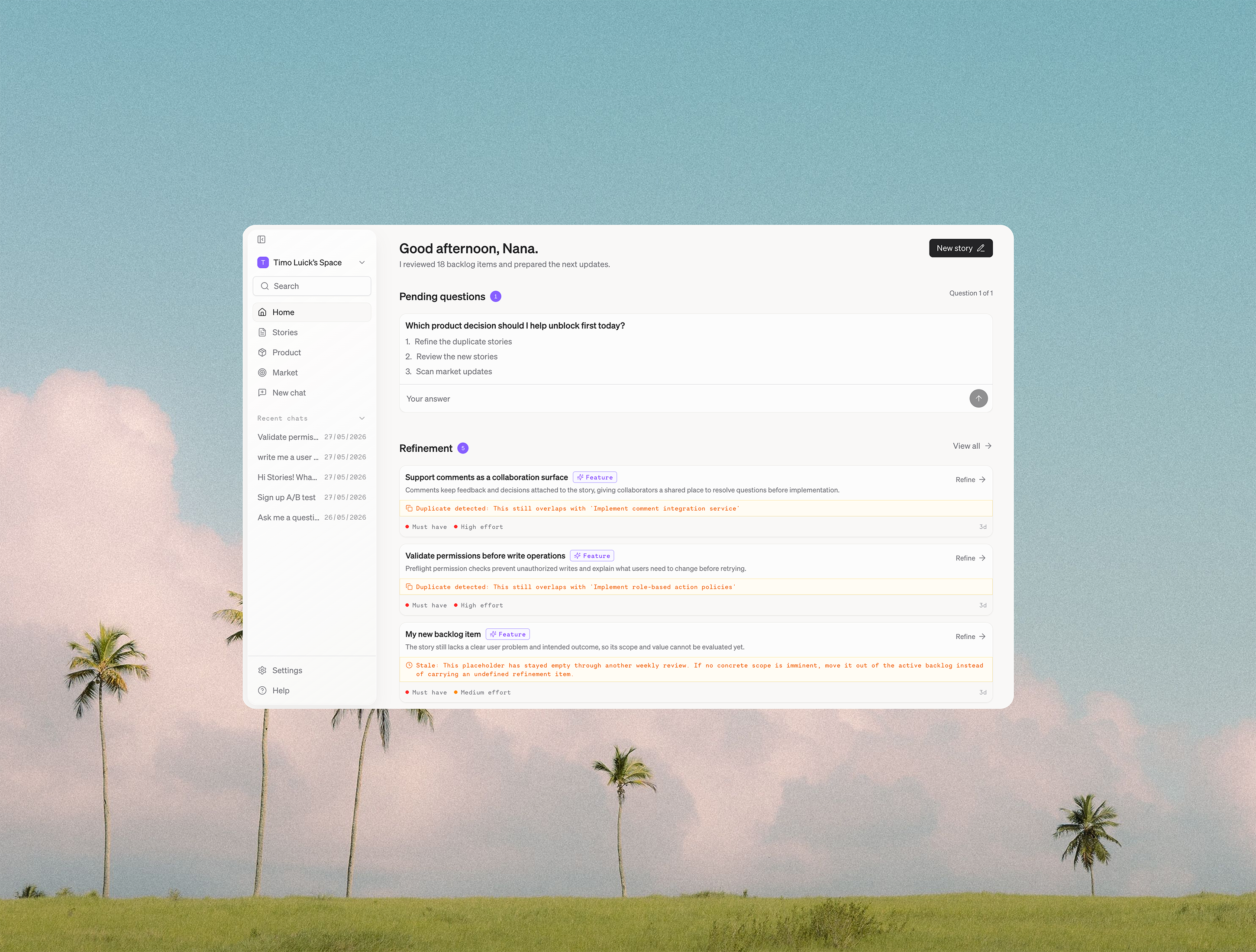
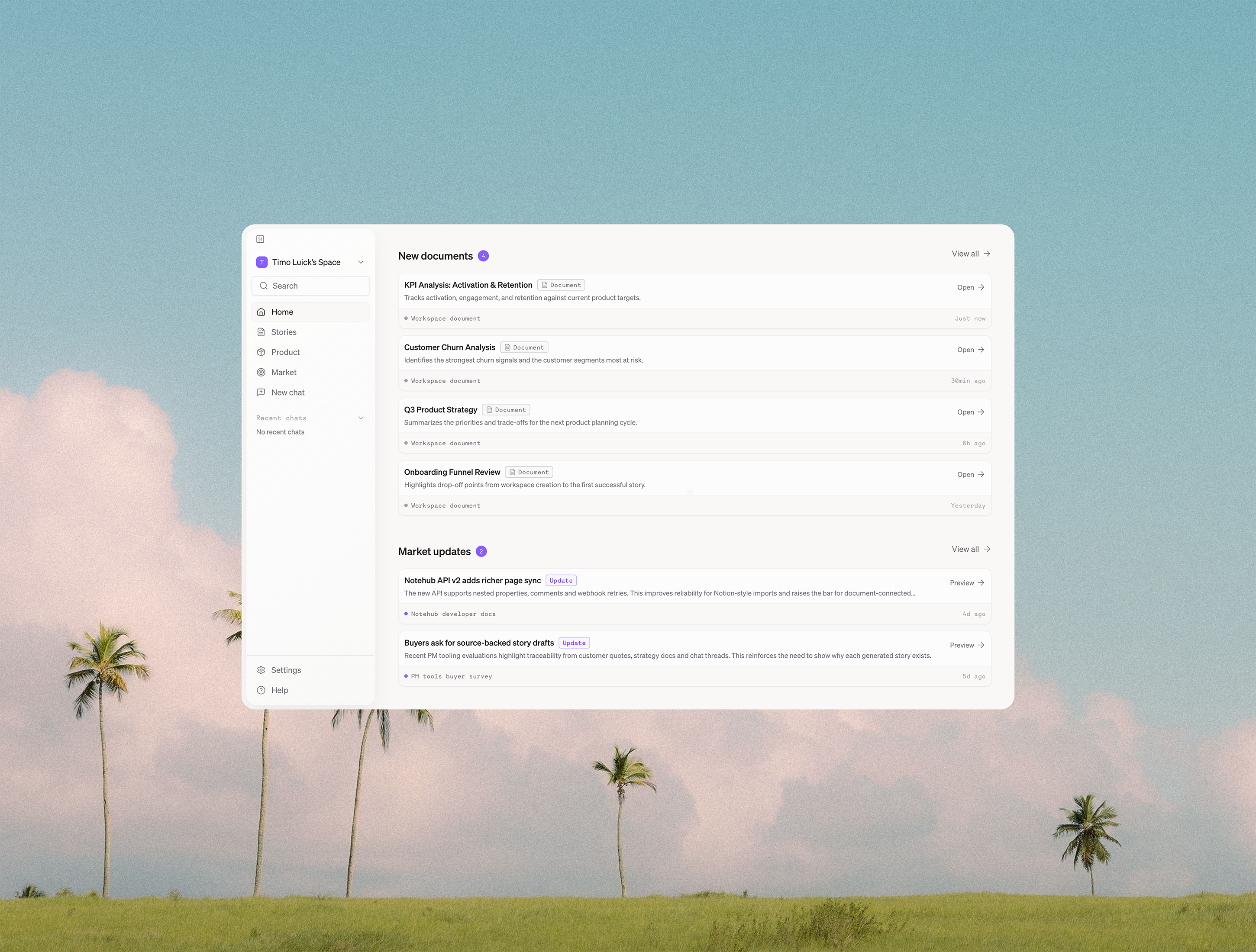
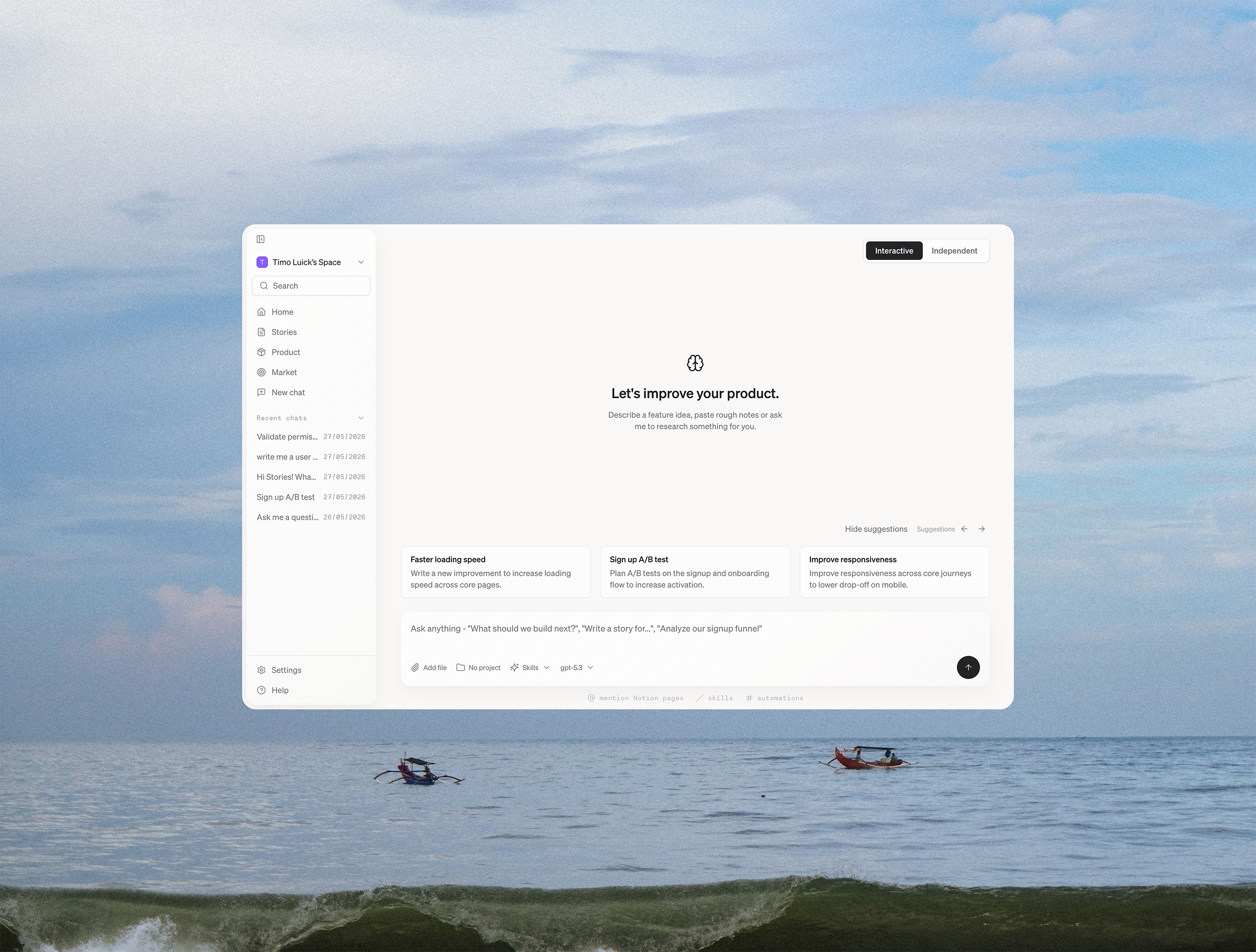
Instead of manually gathering information before every product decision, teams connect Stories to their existing tools. The AI Product Agent analyses documentation, repositories, customer feedback, analytics and existing product knowledge to build and maintain an evolving understanding of the product.
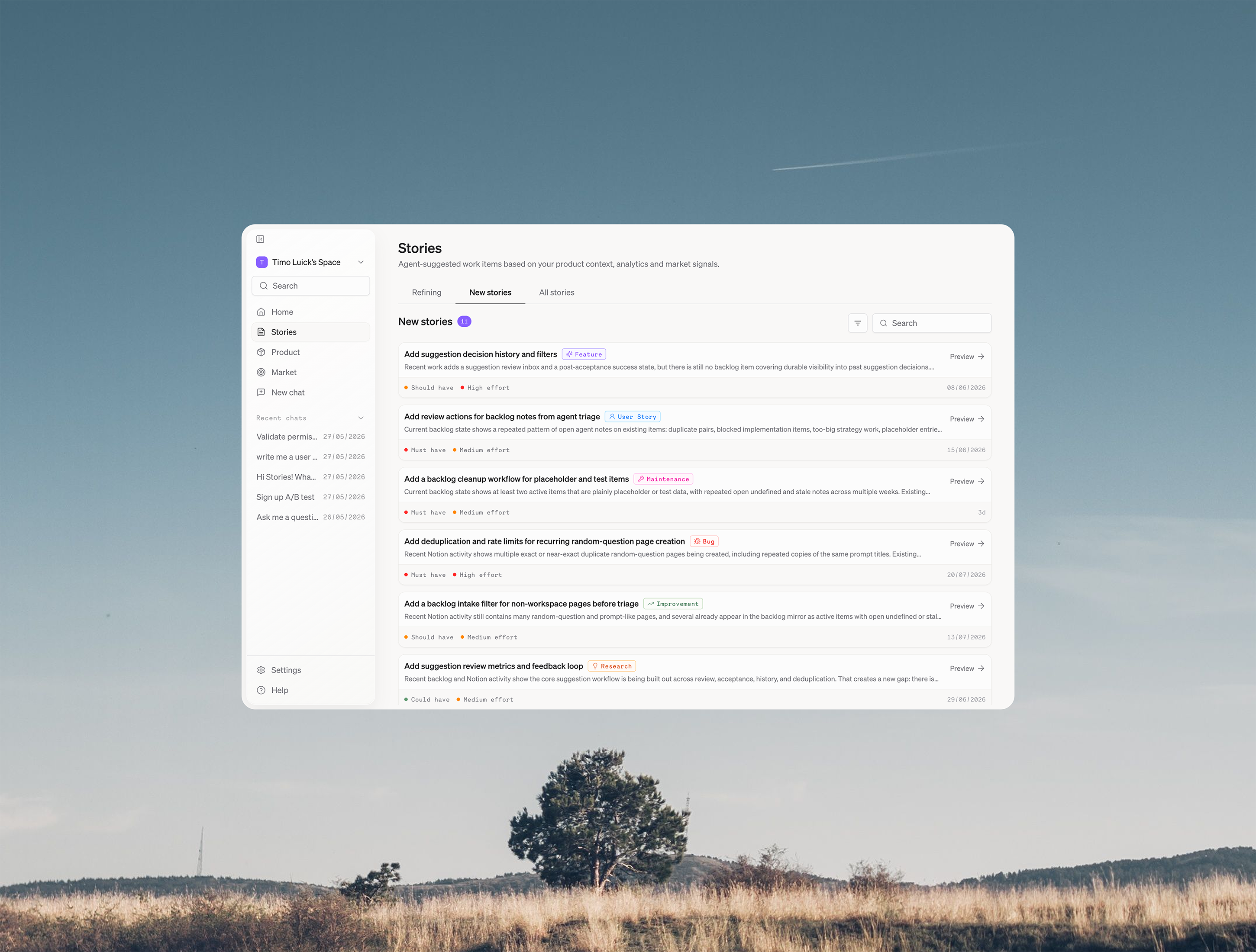
When someone proposes a new feature or product idea, Stories doesn’t simply generate a user story. It identifies missing context, asks clarifying questions, references existing functionality and produces structured, developer-ready requirements that remain fully reviewable before implementation.
Contribution
Stories began with a market opportunity I identified after years of working closely with founders, CTOs and startup teams. Across multiple projects, I repeatedly encountered the same challenges around product clarity, fragmented knowledge and turning ideas into implementation. As the Founding Product Designer, I defined the product vision, led product strategy, product discovery and the end-to-end user experience in close collaboration with our Founding CTO, Timo Luick.
Working in a two-person founding team meant moving well beyond traditional design responsibilities. Alongside product strategy, UX research and interaction design, I collaborated closely with engineering and validated ideas through rapid iteration instead of lengthy design handoffs.
Stories was also the first project where AI genuinely changed how I design products. Instead of stopping at high-fidelity mockups in Figma, I used AI coding tools such as Codex to prototype and build parts of the frontend directly. Designing inside the real product dramatically shortened the feedback loop, allowing product strategy, design and implementation to evolve together. Instead of treating design and development as separate phases, AI made it possible to test, refine and validate ideas much earlier in the process.
Reflection
Stories is currently approaching MVP completion, so success isn’t measured by revenue yet. Instead, we’ve focused on validating the core assumptions behind the product while refining the experience as AI capabilities continue to evolve. The next milestone is testing the product with early users and validating both the workflow and the value it creates.
Next project
Keep exploring work
Octrace